
The US tourist visa is undeniably one of the most popular visas amongst Filipinos. It’s also the hardest visa to get, if not one of the hardest.
What makes this visa popular for Philippines passport holders? For one, it’s valid for 10 years, another reason is that there are many Filipinos living and working in the US. Naturally, Filipinos want to visit their relatives or the Filipinos in the US want their relatives to visit them.
Another reason is that the US simply has so much to offer. From the famous Disneyland, to popularised US cities and landmarks we see in the movies and TV shows and incredible nature – it’s understandable why many Filipinos want to travel there.
I personally applied for a US tourist visa twice. I got denied on my first time, but luckily on the second application – I got my most awaited “approval” from the consul.
In this article, I will walk you through how to get a US tourist visa for Filipinos. I will list the requirements, cost, and step-by-step guide, and answer important questions.
Check our list of 37 visa-free countries for Filipinos as of 2024.
BASIC INFORMATION ON USA TOURIST VISA
I applied for my first attempt on a US visa in Brazil despite holding a passport from the Philippines.
This is because I was travelling in South America at that time. I thought since I’m in that part of the world, why not do the application? If I get approved, I could tour the places I want to see.
Plus, most flights back to the Philippines have a connection in the US and I will need a transit visa or a valid tourist visa anyway to make that connection.
But it didn’t work, I was denied. As common knowledge, as an applicant, you don’t actually know why you’re denied. You’ll be given a “paper” to explain, but it’s a standard letter without specifics.
My best guess for the denial was that I was applying in Brazil, and I didn’t have a residency there.
One of the main things a consul checks on an applicant is the “strong ties” in your home country. And I was not in my home country during that application.
Anyway, I’m mumbling. In this section, you will find some basic, but helpful information regarding US tourist visas such as why is it hard to get, the cost, how long is the process, where to apply, and how soon can you apply.
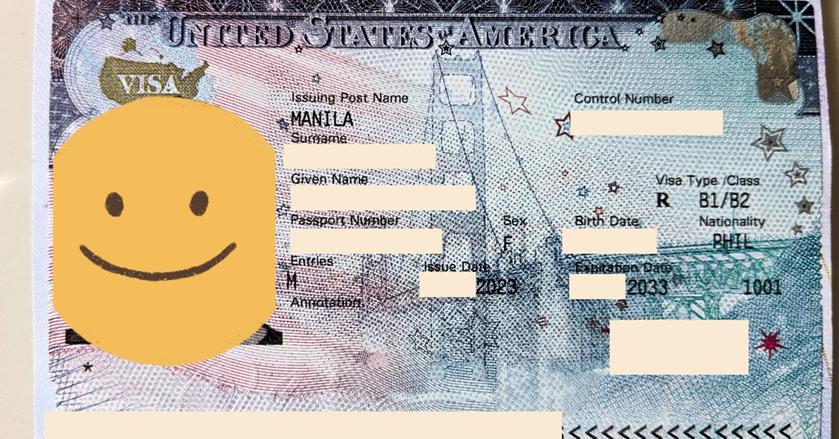
Visa difficulty
On a scale of 1 to 10 (10 being the most difficult or near impossible), I’m giving the USA tourist visa application a 7/10 rating. There is a lot that is taken into consideration for this.
EXAMPLE #1: An applicant who has never travelled outside their home country, doesn’t have a stable income, makes a minimum income, has only been with the company for less than a year, has a nursing degree, has a family living in the US, and has a boyfriend/girlfriend who is in the US might find the application for the US visa to be 9/10 difficulty.
EXAMPLE #2: Same as example #1, but doesn’t have any immediate relatives in the US and doesn’t have a US girlfriend/boyfriend. However, they have a decent income with a company they have been with for at least 5 years, and their field of work is not within the medical field. The difficulty rating could be 8/10.
To give you some ideas, here are the red flags and green flags that the US Embassy might be screening for:
Green flag
- tenure job or at least 10 years with the company or near the retirement age
- travelled abroad, specifically to Europe, Australia, Canada, and New Zealand (countries that require a visa)
- makes at least 40,000 PHP ($800) a month
- job with government branches (teaching, police, BIR, etc)
Red flag
- recent graduate or only been with the company less than a year
- works at the medical field (nursing, doctors, dentists, lab technicians, etc)
- low income (minimum)
- have never travelled abroad or only been to visa-free countries
- has families in the US as permanent residents
- has a romantic partner in the US
- planning to stay in the US for more than 30 days/1 month (more than this is only reality for students on school break, those seeking medical services, and retirees)
How much does US tourist visa cost
The US tourist visa costs US$185, but you pay in local currency. As of November 2023, it officially converts to PHP10,730.00 ($185 x 58 pesos – 10,730 pesos). This could change at any time.
This official US site will show you the current conversion rate.
How long does US tourist visa take to process
Let’s say your application was approved. From the date of approval to receiving your passport, the processing times could take between 3 working days to 14 working days.
My interview or approval date was a Monday. By Thursday, my visa was ready to be picked up. The public holidays, weekends, and if you decide to pick up your passport or get it delivered, could affect the processing time.
This means that if your interview was on Friday, your passport won’t be processed until the following Monday or Tuesday.
Then, if you choose to get your passport delivered (let’s say you live in Visayas or Mindanao), the delivery time could take seven days or more.
Where to apply for US tourist visa
There’s only one place you could apply for a US tourist visa in the Philippines, and it’s the US Embassy in Manila.
There is no US Embassy in Cebu or other parts of the world.
However, for people who qualify for a “waived interview” (meaning you don’t need to be interviewed), you can simply drop off your passport at chosen LBC stores.
Usually, those who qualify for waived interview are children below 18 years old and those who are renewing their expiring US tourist visa.
How soon can I apply for US tourist visa
There is no specific time. You can apply as soon as you can. Since the waiting times for appointments are so behind, it’s understandable that most Filipinos submit their application as early as six months prior to the travel date.
During my second application, I originally planned to travel in November 2024 to the US and get an appointment by March 2023.
However, since I noticed the new slots on the appointment calendar being available, I updated my travel plan to December 2023. I got lucky and found an appointment date four two months before my travel date.
REQUIREMENTS FOR USA TOURIST VISA VISA
In reality, there are actually not many requirements when it comes to applying for a US tourist visa. The main challenge here is the interview.
Imagine you are given around 2-3 minutes to prove yourself to the consul. You have to convince the interviewer that your declared purpose of the trip is actually what you plan to do (and not stay and work illegally in the US).
That’s not a lot of time, but on the other hand, the consul also has very limited time to make such a decision. It is what it is.
Regardless, you must still prepare a lot of paperwork even though 95% of the time, you won’t be asked to present them.
Why still get these papers ready? Because in a very limited possibility that the consul ask for these documents and you didn’t have it, and in the end you get denied – you’ll feel and think that you could have gotten that “approval”, if only you had the asked document. Don’t take that chances.
- 2×2 inches passport photo (70% to 80% of the photo must show your face and ears, no glasses, white background)*
- printed copy of your appointment*
- printed copy of your DS160 confirmation* (not the application or actually DS160)
- travel itinerary (with a list of places you want to see)
- bank statement (at least six months of coverage)
- bank certificate (at least three months old)
- proof of property or asset (land and investment such as stocks)
- business registration
- employment certificate
- pay slip from work (ITR or tax returns from the last six months)
- passport and visa copy of travel companions
- invitation from a business convention (if travelling related to work)
Guide – * meaning 100% required
STEP-BY-STEP GUIDE ON APPLYING FOR US TOURIST VISA FOR FILIPINOS
Below is the step-by-step guide in text. If you want to see the guide in photo form, keep scrolling down to the next section.
UPDATE: We now have a video version of this post. You can watch it on Youtube.
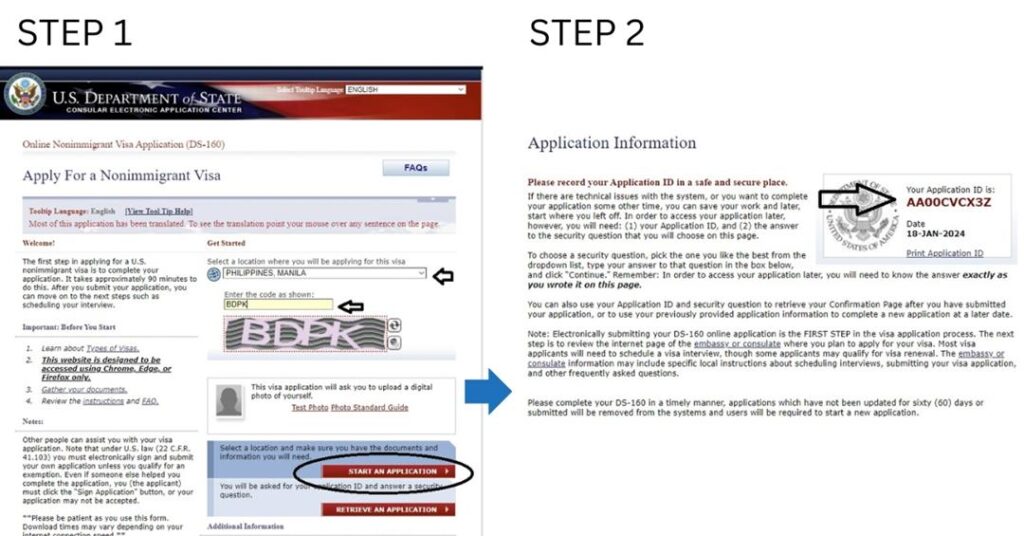
Step 1: Fill out the DS160 application online. Remember and save the confirmation number on the top-right of the page.
- The information asked includes personal details, travel history, point of contact in the US (could be family or the hotel you plan to stay at on your first night), employment history, education history, work information (how much your salary and number of years with the company), and in the end, you will be asked to answer security questions.
- You don’t need to finish the application in one sitting, you can save it and come back later.
- You will be uploading your digital photo on this step.
- Check at least twice all the information, make sure they are correct before submitting.
- Once submitted, you cannot edit this.
- The DS160 is active for 30 days. This means you must pay the visa fee in 30 days.
Step 2: Create an account on the Portal. Use the same email address you used on your DS160 application. Fill out the details.
- If you made an error on your application form, you can instead fill out a new DS160 form and update the “application number” on your portal before your appointment.
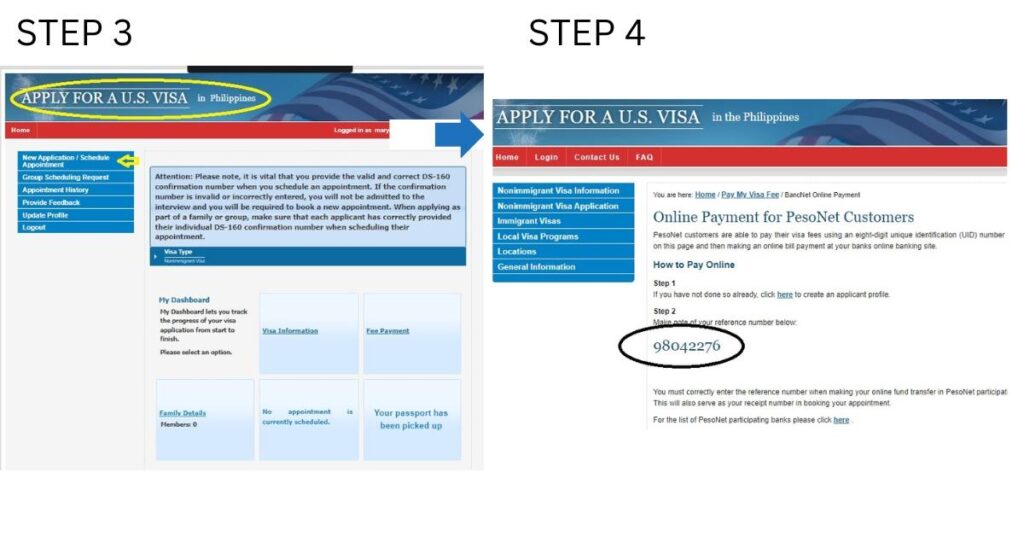
Step 3: Pay the fee (called the MRV fee). This is actually confusing because once you finish the application online, there’s no link that directs you where to pay or how to pay. Click here for that information.
- After you load that link, write down the “8 digit code” under “step 2” and the bank details (under step 3) to which the payment must be sent to.
- When paying, you can either pay directly over the counter of any RCBC or use your online banking.
- The way the payment works at the bank is you will include the “MRV fee 8 digit code” in the “account details of the receiver”. The RCBC staff should be able to assist you with this.
- To pay using your bank account, it’s basically “transferring money/sending money”. The bank drop-down on your online banking should have “Citibank N.A”.
- I tried online payment using BDO and Landbank. It doesn’t work on BDO (Citibank N.A. is not the option, but Landbank has it – BPI and RCBC should also have it).
- Enter the bank details you found on the link. When filling out the “account number”, you must include eight of 7 (77777777), then the “MRV fee 8 digit code” you found on the link.
- Let’s say the link gave you 12345678, the bank account number will look like this “7777777712345678”.
Step 4: Schedule an appointment. Log into the portal. If the payment was made between Monday and Thursday, your payment should be reflected here.
- To see that, click “schedule an appointment and fill out your details. Click continue until you see the “visa fees”, and put on your MRV fee code (the 12345678 sample I made). The page will show you if the payment went through by allowing you to choose a date.
- The dates or slots available are often five or six months away. There’s a trick here.
- The US Embassy is trying to close the long appointment times. As part of the effort, they open new slots unannounced.
- This means you can refresh the scheduling link (the portal) to see new dates.
- But don’t refresh too often, as you will get blocked for 24 hours. Usually, new slots come at midnight or in the afternoon.
UPDATE: The US Embassy announced in September 2024 that there will now be a seperate appointment for biometric collection. This appointment will be held at the VAC located at Parqal Building 8, Level 3, Diosdado Macapagal Boulevard, Barangay Tambo, Parañaque City.
You have to attend this biometrics appointment before your interview. Bottom line, there are now 2 appointments (1. VAC for biometrics and 2. at the embassy for interview). This change will come into effect starting September 28, 2024.
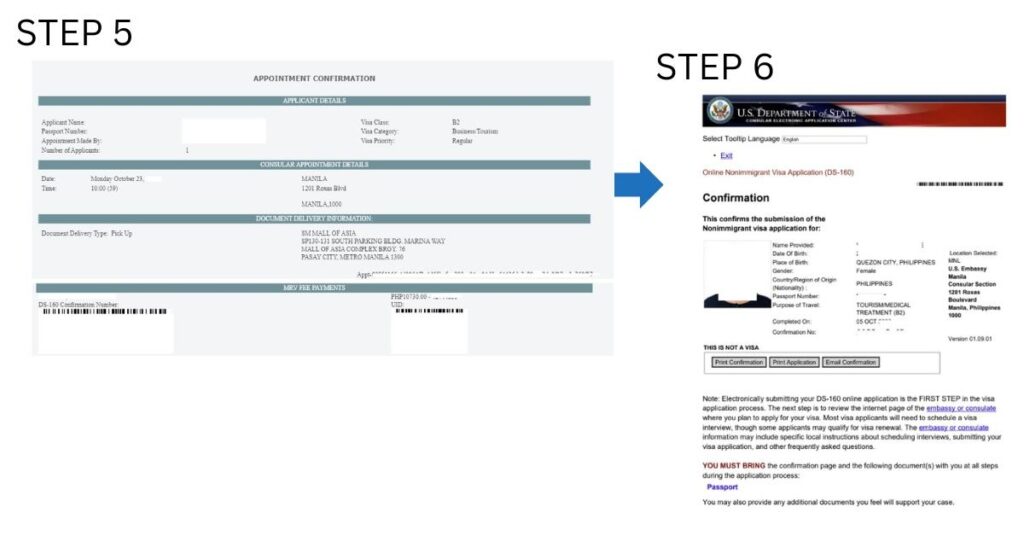
Step 5: Print your schedule confirmation. Once you choose the date and time, make sure to print the schedule confirmation.
- You can reschedule at least once.
- The MRV fee is non-refundable and valid for 1 year.
- Let’s say you paid the MRV fee, but haven’t scheduled an appointment yet. That’s ok; just make sure you schedule the appointment within a year from the payment date of the MRV fee.
Step 6: Show up to your appointment date. You could actually enter the Embassy 30 minutes before your appointment, although it says 15 minutes.
Step 7: Do the interview. You will be asked around 3-6 questions. The interview lasts for around 2-3 minutes.
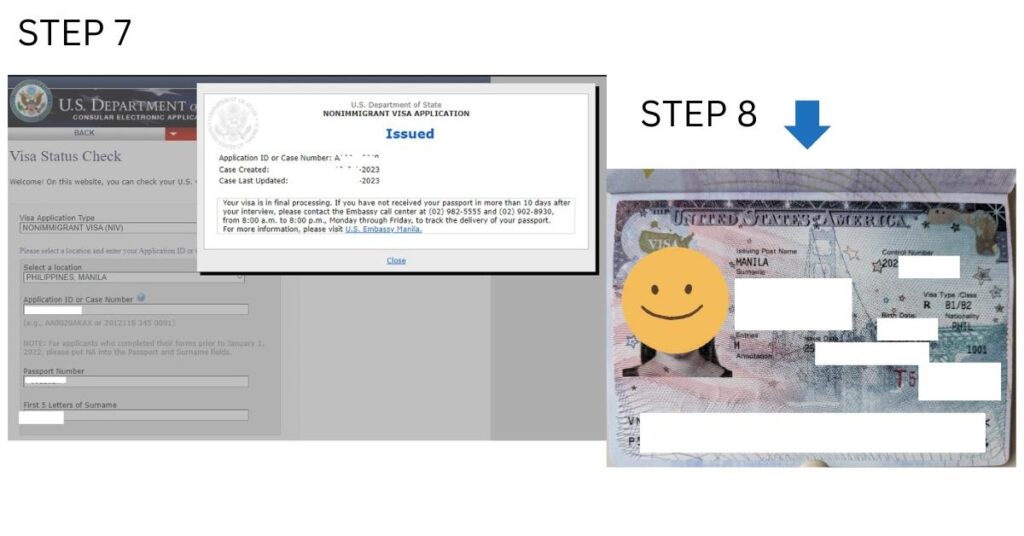
Step 8: If approved, you will be told that your passport will be ready in one week to two weeks.
Step 9: If denied, your passport will given back to you with a blue or pink paper explaining the reason why you were denied.
VISUAL GUIDE
FAQ
- Can I edit my DS160
- Once you submit your DS160, you cannot edit it. But you can create a new one. If you already paid and scheduled an appointment, you can still create a new one and enter the new application number on your portal account before your scheduled interview.
- Do I need to book flights in advance?
- No, it’s actually recommended that you not book anything until your visa is approved or you have received it. The consul won’t ask for it during your interview.
- What to wear during the interview?
- Semi-formal. Cover your shoulders and clothing below your knees. Even a shirt and jeans are okay. The key point is to make yourself look presentable. What you would wear in a job interview works, but a simple dress, a long-sleeve shirt, or a skirt are all fine as well, and wear closed shoes.
- What can I bring during an interview?
- Apart from your documents, there are a lot of things not allowed inside the embassy. You cannot bring anything sharp (swiss knife), liquid (including water or hand sanitiser), or anything electric with an on/off switch (mobile phone, smartwatch, ebook reader). Basically, you can only bring paper, a pen, your wallet, and your keys. You can bring an umbrella.
- What if I couldn’t find an appointment date before my planned travel date?
- That’s okay. You can create a new DS160 with a new planned travel date or keep refreshing the appointment date until you find a new date that works for your currency DS160.
- How soon can I re-apply?
- If you get denied, you can reapply as soon as possible. But make sure that there has been significant change since the last application (e.g work with better salary, you travelled outside the county, etc)
COMMON QUESTIONS DURING THE INTERVIEW
Here are some common interviews I learnt during my reserach and from my own experience. Perhaps, these could help you too. Remember, there are a lot of possible questions, the questions are not limited to the following:
- Where are you going
- What is the purpose of your trip
- Are you married
- Do you have children
- Where are your children
- Where is your husband/wife/partner
- Who is paying for your trip
- Are you visiting anyone in the US
- Are you travelling with anyone
- How long do you plan to stay in the US
- What is your job
- What is your salary/How much do you make
- How long have you been with this company, and what was your job before this one
- What does your business do
- How long have you had this business
- Have you travelled outside the Philippines before
- On those trips, were you travelling alone
- Do you have a family in the US, and what is their status in the US
- Why do you think you were denied a US tourist visa before
INTERVIEW TIPS
- Be confident. Believe that you are going to get that visa approval.
- Smile and greet the consul. (Good morning, how are you?)
- Be honest. Make sure your answer matches your answers on your DS160. If anything has changed since, you should disclose/mention it to the consul to avoid looking like you’re lying (for example, “In my DS160, I didn’t include Japan in my travel history, this is because I filled out my application three months ago, and only last month when I travelled to Japan”).
- Elaborate your answer a little bit, but not too much. (for example, “I’m going to California and Las Vegas. I’m a big Disney fan, and it’s been my dream to visit Disneyland. I also really want to see Las Vegas and try out those popular buffets!)
- Who is funding your trip? The best answer here is self-funded to show you’re self-sufficient. Funded by a family member or your partner only works if you’re a senior citizen or a minor. If you don’t have a job right now, you can still say self-funded if you can prove that you have strong savings or have a business on the side (for example, you are unemployed because you want to take a sabbatical leave, explain to the consul that your unemployment is by choice and you’re looking to take a break from work that’s why you’re going on this holiday).
- Mention all your travel history, especially if you haven’t travelled abroad in the last 5 years. You can explain why (for example, I haven’t travelled in the last five years because I focused on starting up my business.)
- Practice your interview answers. Don’t memorise the answers and recite them like a presentation. Practising in advance or speaking out loud gives you confidence and lets you realise where you get nervous and stutter. Practice with someone or record yourself so you can watch it and see where to improve. Practising just in your head doesn’t do as well as saying your answers out loud.
Speak with the consul as if you’re talking to a friend, a friend that you really want to impress (without lying of course!). Think of the consul as someone you’re trying to describe about your upcoming trip.
TIPS FOR FIRST-TIME APPLICATION AND APPLICANTS WHO WAS DENIED BEFORE
- Make your travel history stronger. Instead of going to the US as your first trip, go to visa-free countries first such as around Asia or Southeast Asia. Then, apply for a South Korea, Japan, or Schengen visa. Holding a visa from Europe, Australia, New Zealand, Japan, South Korea, and Canada can really help with your US tourist visa application. It’s a lot easier to get those visas anyway compared to the US visa.
- Analyse your red flags and see what you can do about it. You plan to visit your family in the US, but your purpose for the trip is tourism. That’s okay, but planning to stay with your family instead of a hotel could raise some questions.
- Funded by a family or a partner? How about wait a few more months and save some money? Plan to spend around $150 a day. So, if you’re going for 14 days, save around $2,000. Your partner or parents can gift you a flight ticket, but you must pay for the majority of the cost, such as your hotel, food, tours, and transportation.
- Your business is now registered or stable. Before, your business was only less than a year old, unregistered, and not making much money. But this time, you are now registered with DTI, BIR, with business permits, you are now making way more than the minimum salary, and you now have employed staff allowing you to take a 10-day vacation.
- Re-apply? It’s important that you can show there have been any changes since your last interview. For example, you’ve travelled to Europe and now have a Schengen visa on your passport, or your salary is now more than before, or you are now able to save money, and this trip will be self-funded).
CONCLUSION
To be honest, there’s no way of telling if you’re going to get approved or denied. I’ve heard so many stories of people with strong travel histories, great salaries and jobs, and have answered the questions perfectly and still got denied.
I also heard of people who never travelled abroad, make 20K a month (pesos), have only been with a company for a year, have single status, and were approved.
There’s no magic word or secret word or secret ingredient to ensure approval.
It’s pretty much always a 50:50 chance. Plus, you need to take into consideration the mood that the consul will be in during the interview, after all, they’re human with emotions that could affect their judgements.
But to say you should not try at all especially if this is something you really want, you must give it a shot. There’s a guy I know who tried four times in the span of ten years. On his fifth time, he finally got his visa.
I hope that you found this guide on US tourist visa for Filipinos helpful. I totally understand how stressful, confusing, and costly this visa could be. But if it’s a destination you really want to see, it’s truly worth the effort.